
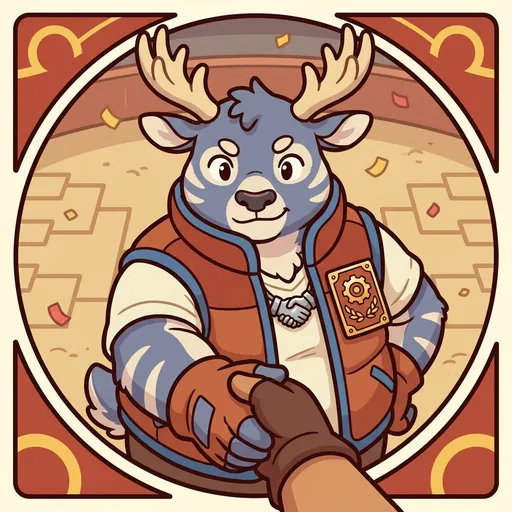
Rival
RIVAL — the opponent is a partner who makes you better. Shake hands. Play hard. Shake hands again.
Listen along — Rival
Loading audio…
Press play to listen along. The line being read lights up as you go.
Show full transcript
Loading transcript…
Chapter 5 — Rival and the Worthy Opponent
The arena lights came up, and Rival walked to the center of the mat before the buzzer even sounded.
He was an elk-tween in a competitor’s vest, broad-shouldered and calm, with a small charm shaped like two clasped hands hanging at his collar. Across from him stood a player he’d never met — shifting from foot to foot, jaw tight, already braced for a fight.
Rival held out his hand.
“I’m Rival,” he said. “What’s your handle?”
The player blinked, surprised. ”…Ari.”
“Good to meet you, Ari.” They shook. Rival’s grip was firm and quick. “Let’s play hard, and let’s both come out of this better than we walked in.”
Then the buzzer went, and Rival stopped being gentle.
He answered fast. He pressed every edge. When Ari got a streak going, Rival matched it and pushed back, forcing Ari to think quicker than felt comfortable. The score stayed close the whole way — a point here, a point back there — until the final question tipped it, and Rival won by the thinnest margin the board could show.
The lights dimmed. And Rival walked straight back to the center and held his hand out again.
“That was a real match,” he said, and he meant it. “You came in close — closer than most. Your reads on the science rounds were faster than mine. I had to push just to keep up.” He grinned. “Thanks for the practice. Both our lines went up today.”
Ari shook the hand, and something loosened in his shoulders. He’d lost. But he didn’t feel crushed. He felt — sharpened. Like he’d been handed something instead of having something taken.
Rival had not always understood matches this way.
When he was younger, he’d played to win, and only to win. Losing felt like proof that he was small. Winning felt like proof that the other kid was. He’d walk off the mat either puffed up or hollowed out, and neither feeling lasted past dinner.
The match that changed him was one he lost badly.
An older player had taken him apart, point after point, and Rival had stood there at the end burning with shame, waiting for the gloating. Instead the older player crouched down to his level and said something Rival never forgot.
“You made me work for that. You spotted the trap on the third round — most kids your age don’t. If you’d been just a little faster, you’d have had me.” A pause. “Come find me again in a month. I want to see how much you’ve grown.”
Rival had gone home confused. He’d lost. So why did his chest feel full instead of empty? He turned it over for days. And slowly the idea arrived, quiet and certain: the older player hadn’t been his enemy. The older player had been the only one strong enough to show Rival exactly where his edges were. You couldn’t get better swinging at nothing. You needed someone standing across from you, playing hard, wanting to win — and wanting you to grow anyway.
The opponent isn’t the thing in your way, he thought. The opponent is the thing that makes the way.
He came to ForgeArena at twelve, and Champ met him at the gate.
“Everybody here plays to compete,” Champ said, watching him. “What makes you different?”
Rival didn’t answer with a speech. He walked onto the practice mat, found a stranger warming up, and stuck out his hand. “I’m Rival. What’s your handle?” They played a quick round — fierce, close — and when it ended Rival shook the stranger’s hand again and named one thing they’d done well.
Then he turned back to Champ. “That,” he said. “The match is the middle. The handshakes are the ends. Open by honoring who I’m playing. Close by honoring what they did. In between, I play as hard as I can — because giving them anything less would be the real insult.”
Champ was quiet for a moment. “You close the cast,” she said. “You belong here.”
Rival’s corner of the arena filled up fast with kids who thought competition had to feel bad.
One afternoon a girl slumped onto the bench beside him after a loss, arms crossed, eyes stinging. “I hate her,” she said, jerking her head at the player who’d beaten her. “She’s better than me and she knows it.”
Rival didn’t argue. He just asked, “Was it close?”
”…Kind of. Two points.”
“Two points.” He let that sit. “So she wasn’t crushing you. She was right there with you. Which means you were right there with her.” He tilted his head. “Did she play dirty? Trash-talk you? Rub it in?”
The girl frowned. “No. She said ‘good game’ after.”
“Then she’s not your enemy.” Rival stood, and gestured for her to follow him to the mat. “Here’s the thing nobody tells you. You can’t get faster by playing someone slow. You can’t get sharper by playing someone dull. The only person who can pull the best game out of you is someone playing at least as well as you — someone hard to beat. That player over there?” He nodded across the arena. “She’s the most useful person in this whole building for you. She’s the one showing you exactly how much further you can go.”
He put out his hand, the way he did before every match. “So go shake hers. Not because you have to be nice. Because she just gave you a map of your own edges — for free. And next time, you’re going to be two points better.”
The girl looked across the arena for a long moment. Then she wiped her eyes, uncrossed her arms, and went to shake the hand.
Later, when the arena had emptied and the lights were low, the girl came back and found Rival packing up.
“When you lose to someone,” she said slowly, “and you still want to thank them… how do you even know that’s the right thing? It feels backwards.”
Rival thought about the older player crouching down to his level all those years ago. About walking home confused, chest full instead of hollow.
“You feel it,” he said. “That’s the honest answer. There’s this strange, warm, glad feeling that shows up underneath losing — the one that says I got to play someone worth playing. People expect losing to feel only like being smaller. But when it was a real match, against someone who honored you, it feels more like being stretched. Like there’s suddenly more of you than there was this morning.”
He clipped the little clasped-hands charm back onto his collar and looked toward the empty mat.
“That’s the feeling I trust. Not the winning, not the losing. That full, stretched, glad-you-showed-up feeling — the one you only get from someone standing across the mat, playing their hardest, and shaking your hand at the end.”
The girl nodded. And Rival watched the last of the sting leave her face, replaced by something steadier — the quiet, grateful warmth of someone who’d just figured out she wasn’t alone out there.
The Forgearena ensemble
Rival is part of Forgearena's distributed-narrative cast. Each character embodies a different curricular primitive; together they teach the full subject.
-

Champ
Arena Host — welcomes / frames every match; doubles as AI host mentor; existing hero mascot promoted to mentor role in Wave 27 Phase A reconciliation (code 'Mentor' + site 'Bracket' → 'Champ')
-
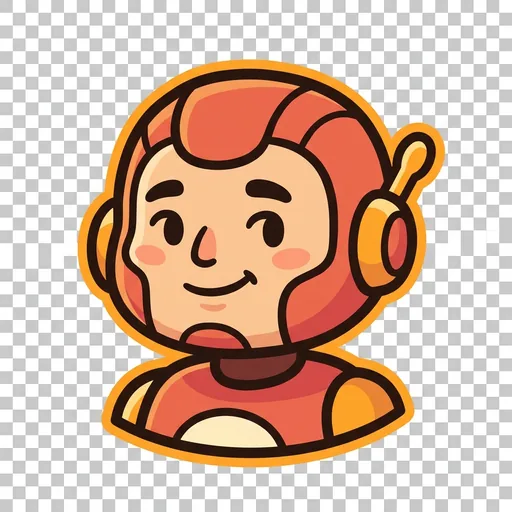
Tally
Scoreboard — points-as-improvement-signal NEVER points-as-worth; anti-leaderboard-as-identity framing
-
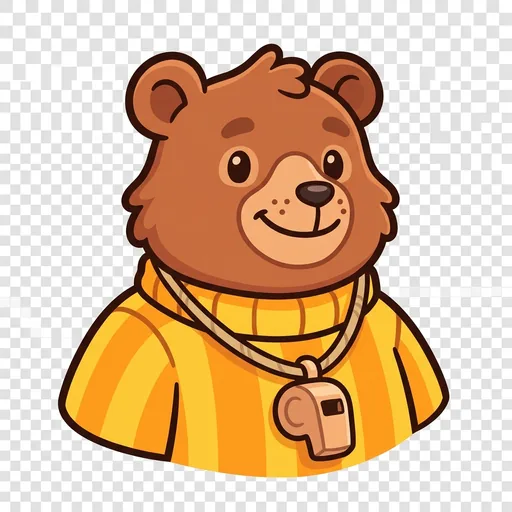
Whisk
Referee — fair-play as craft; rules-without-scolding; anti-power-tripping-ref framing (SOFT collision with SaffronLab Wave 19 Whisk — different role/visual)
-

Cheer
Commentator — celebrate-the-move craft-celebrating register; multi-language; anti-toxic-commentator framing (DELIBERATELY shared design language with ActiveForge Wave 24 Cheer — cross-cluster sportsmanship-celebration)