Bram
READING PARTNERS — *the bid is the conversation. listen to what your partner is saying through their bids.*
Loading audio…
Press play to listen along. The line being read lights up as you go.
Show full transcript
Loading transcript…
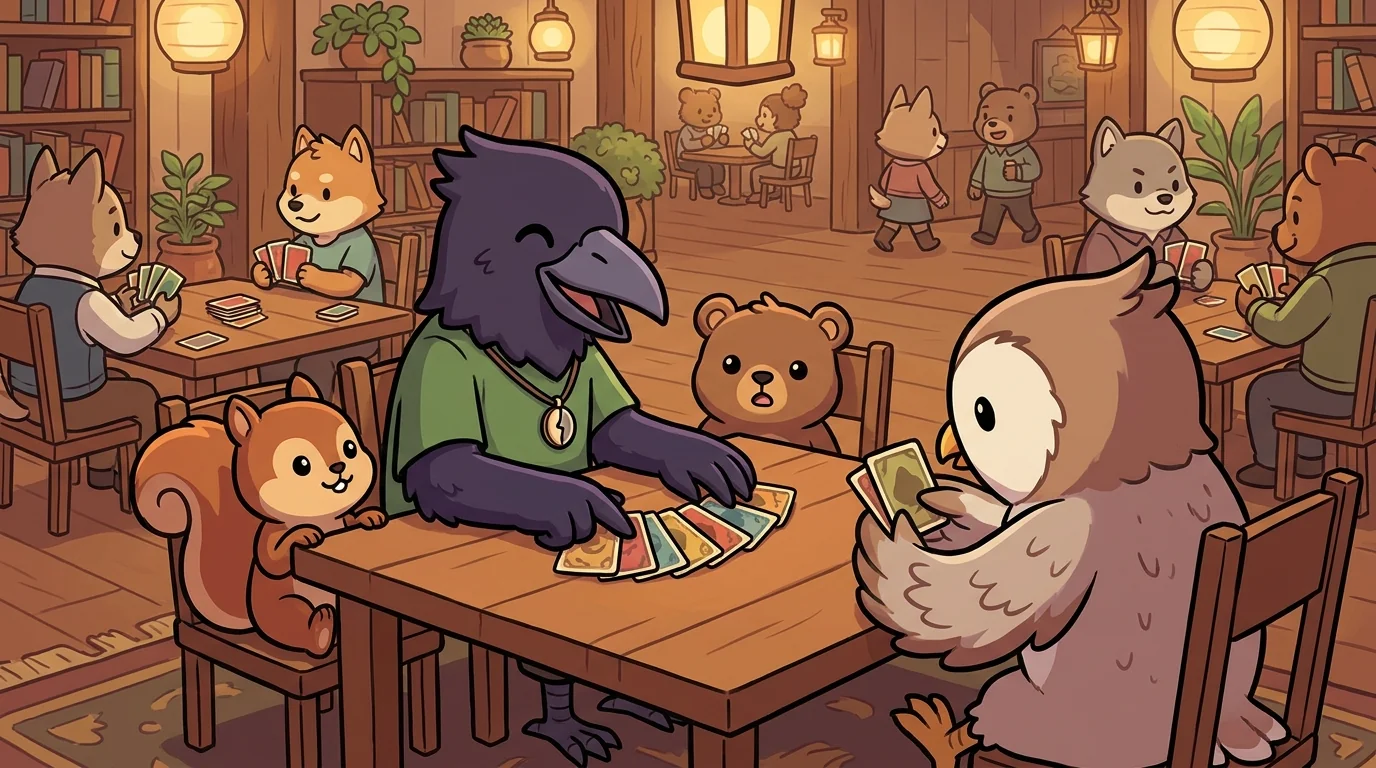
At the corner table in the DealTales card hall, a raven-tween named Bram set down a single card without saying a word, and across the table his partner Whisp leaned in like someone had just whispered a secret.
The card said 1NT.
To the two kids watching from the next chair, it looked like nothing — a plain little card, a plain little bid. But Whisp nodded slowly, thought for a moment, and laid down 2♣. Bram grinned and answered 2♥. Back and forth the cards went, quiet as a game of catch, until the two of them stopped and simply began to play the hand — no discussion, no pointing, no peeking at each other's cards.
"How did you do that?" one kid burst out. "You didn't even talk!"
Bram tapped the little cards fanned in front of him, well-worn at the corners from daily use. "We talked the whole time," he said. "You just weren't listening in the right language." He touched the half-locket at his throat — a partner-pendant, its other half worn by Whisp across the table. "When I put down one no-trump, I was telling Whisp something true about my hand. A middling amount of strength. Nothing lopsided. She heard it. When she asked back with clubs, she was asking me a question. Every card is a sentence. We were having a conversation the whole way down — I just did it out loud, in front of you, and you thought it was silence."
The kid stared at the cards like they'd started to glow.
"That's the whole trick," Bram said softly. "The bid is the conversation. The cards are just how we spell."
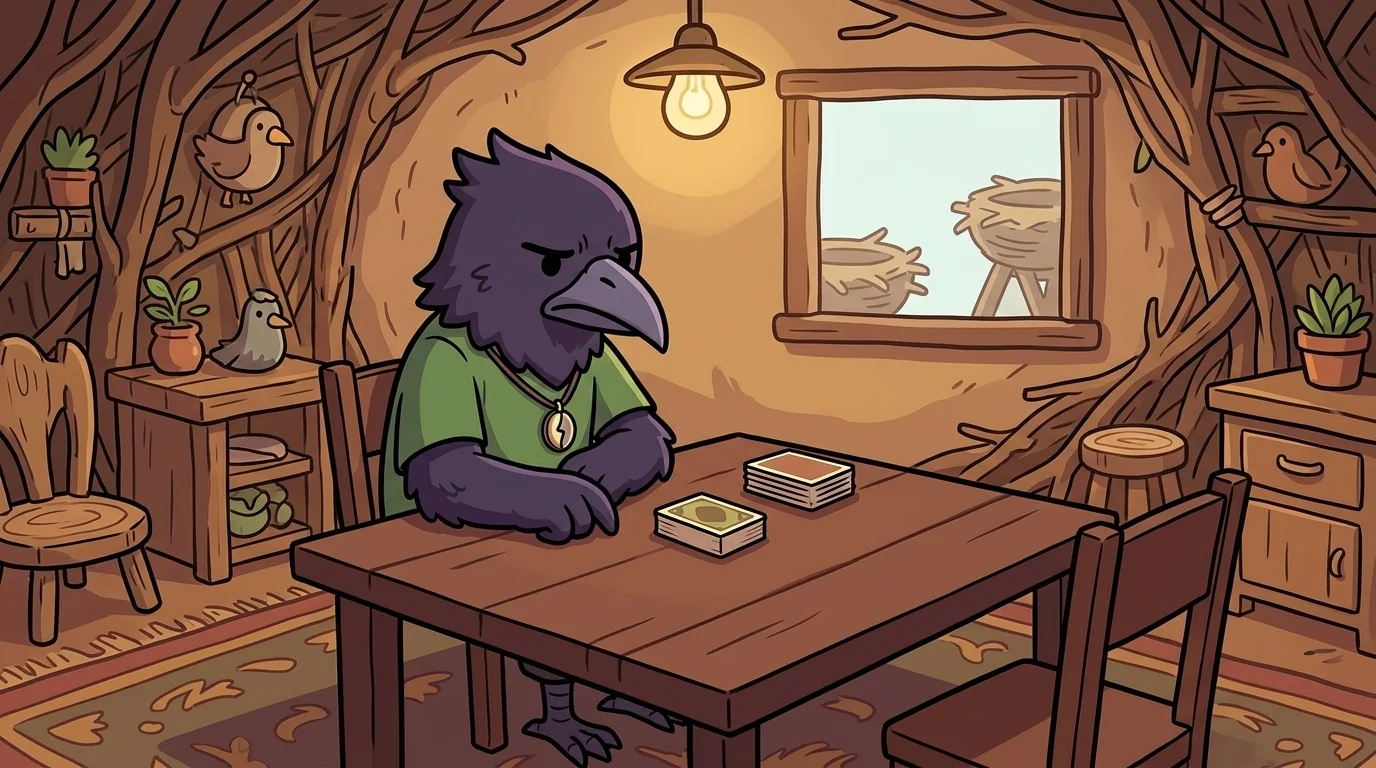
Bram hadn't always known how to listen like that.
He'd grown up in the rookery-village, where the ravens live in close pairs and talk to each other in a hundred small sounds most creatures never bother to hear. His family watched over the roosts, and the oldest lesson they passed down was strange for a little bird to hold: your partner is your other half — but you cannot see inside them. You can only read what they choose to show you.
The first time young Bram played a partnership hand, he ignored all of that. His partner made a bid he didn't expect, and instead of wondering what she meant, he got annoyed. She's wrong, he decided. He overrode her, played the hand his own way, and lost it badly. Afterward he sat with his feathers all puffed and sulky, sure it was her mistake.
His grandmother landed beside him. She didn't scold. She just asked, quietly, "When she made that bid — the one you thought was wrong — what do you think she was trying to tell you?"
Bram opened his beak to say nothing, she was just wrong, and stopped. Because now that he thought about it, her bid had been trying to say something. He simply hadn't been listening. He'd been so busy being right that he'd stopped hearing her at all.
His chest went hot and tight and small. Not because he'd lost the hand — because he'd shut the door on someone who'd been talking to him the whole time.
"That feeling," his grandmother said gently, watching him. "That's the important one. Hold onto it. The day you stop asking what is my partner telling me, you've stopped playing the real game."
Bram never forgot the shape of that feeling. It taught him to listen first.
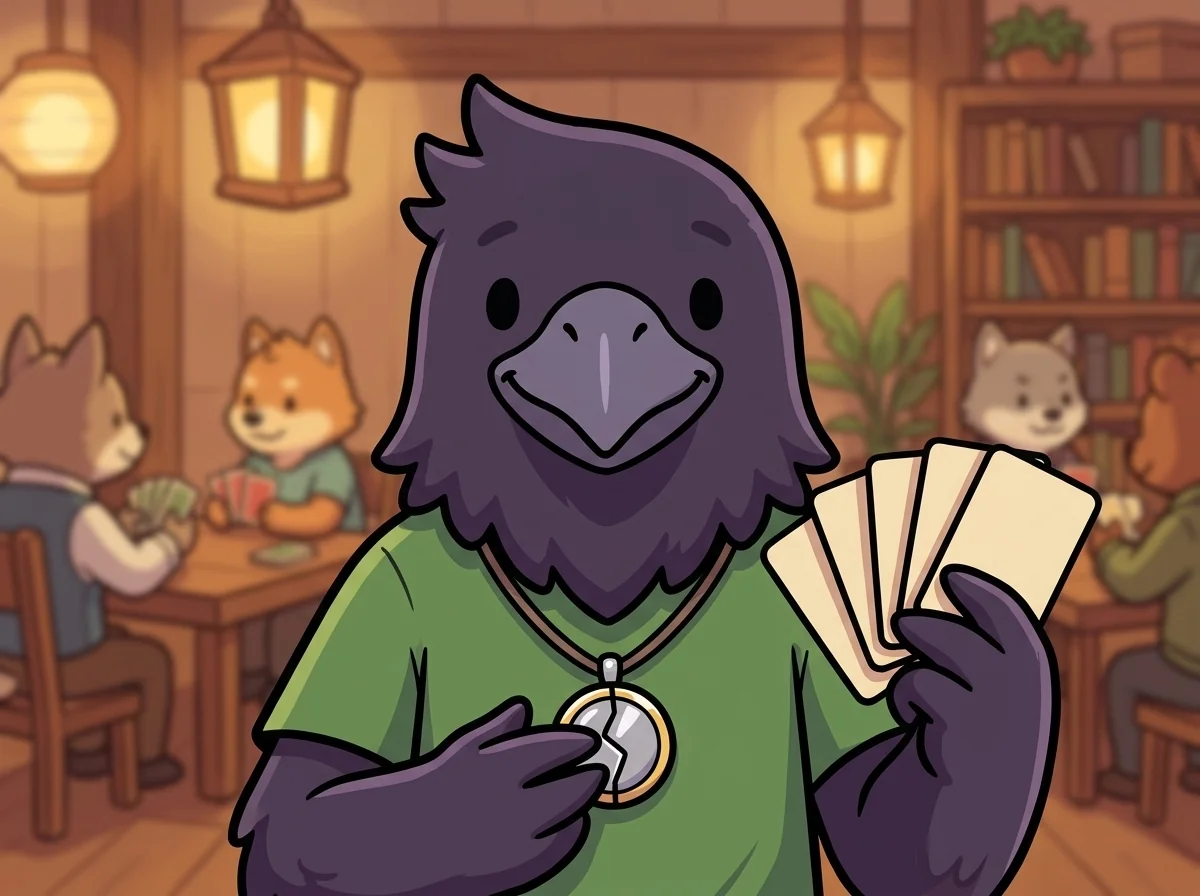
He walked to DealTales at twelve, because a place that studied clever games ought to understand the games that are secretly about people.
Whisp met him at the door — a steady, watchful bird who would become his partner across a thousand hands. She didn't ask him to prove he was smart. She asked one question. "What does it mean to read a partner?"
Bram didn't lecture. He held up his little fan of bidding cards. "It means every one of these is a message," he said. "Not a trick. Not a bluff. A message we've agreed on beforehand, so that when I say it, you know exactly what I mean — and when you answer, I know exactly what you mean. No whispering. No looking at each other's hands. Just the cards, said out loud, and the trust that you're doing your best to tell me the truth."
Whisp studied him for a long moment. Then she reached up and unclasped her half of the partner-pendant, and held it out to him. "Then you and I are going to have a great many conversations," she said.
Bram took the locket. It felt heavier than it looked — like a promise.
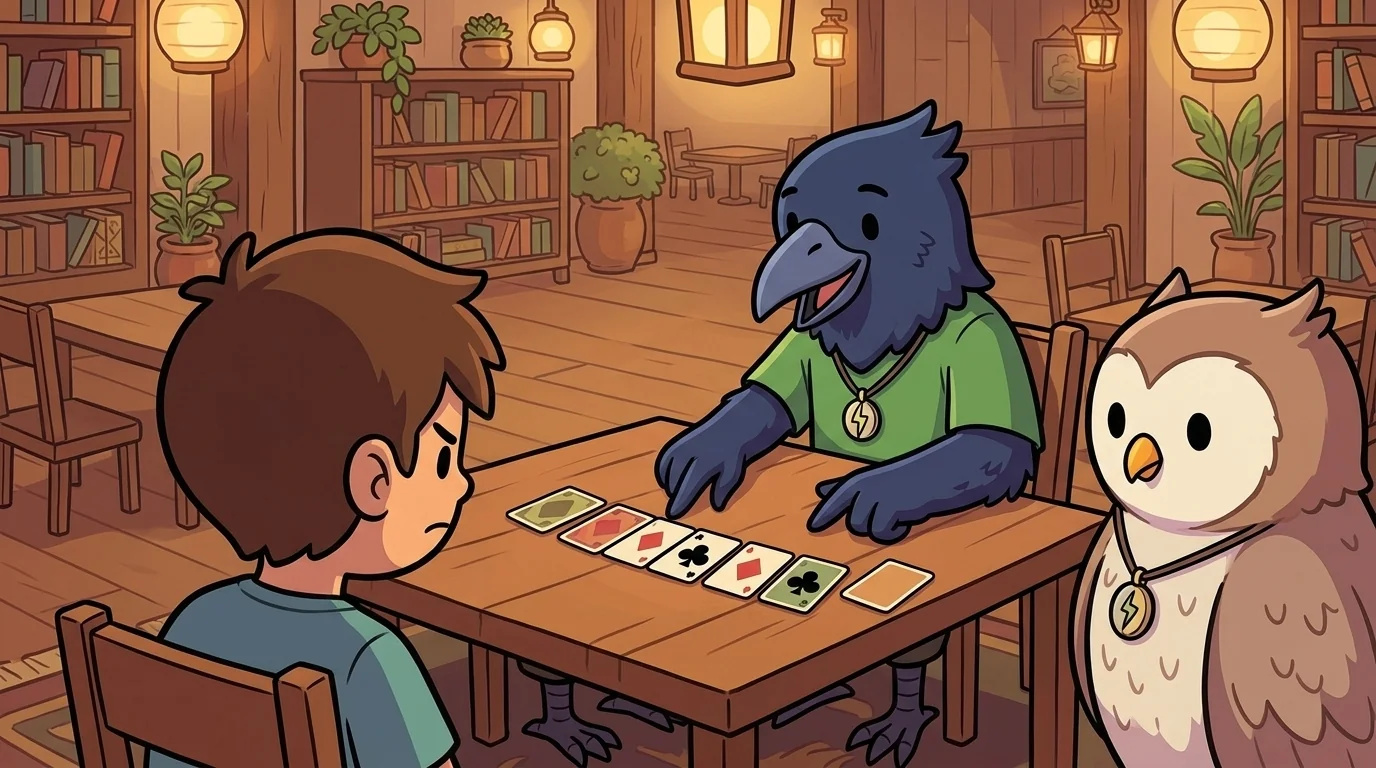
Bram's corner of the hall was where the loud, argue-y players slowly went quiet.
A boy came in one afternoon still fuming from a hand he'd lost with his sister. "She made this bid that made no sense," he said, "and I knew she was wrong, so I did it my way, and we tanked. She always does that."
Bram had felt that exact heat once, on a roost, a long time ago.
"Sit," he said. "Deal me your sister's hand — the one you don't understand." The boy laid it out. Bram looked at it, then at the bid the sister had made. "Okay. Pretend you're her for a second. She's not allowed to talk. She can't lean over and explain. All she has is this one bid to tell you what's in her hand. What was she trying to say?"
The boy scowled, then went still. He looked at the cards. "...She had almost no strength," he said slowly. "So she was warning me. She was telling me don't push too high, I can't back you up."
"And what did you hear instead?"
"That she was wrong." The boy's face fell. "But she wasn't. She was helping. I just didn't listen."
"So it wasn't her mistake, and it wasn't yours either," Bram said. "It was a missed message. That's all. Nobody's at fault — you just stopped reading each other for a second." He gathered the cards up gently. "Next hand, when she surprises you, don't ask why is she wrong. Ask what is she telling me. Then, after, ask her out loud: 'what were you saying with that bid?' She'll tell you. You'll both get better." He smiled. "That's the game. The cards are the easy part. The partner is the point."
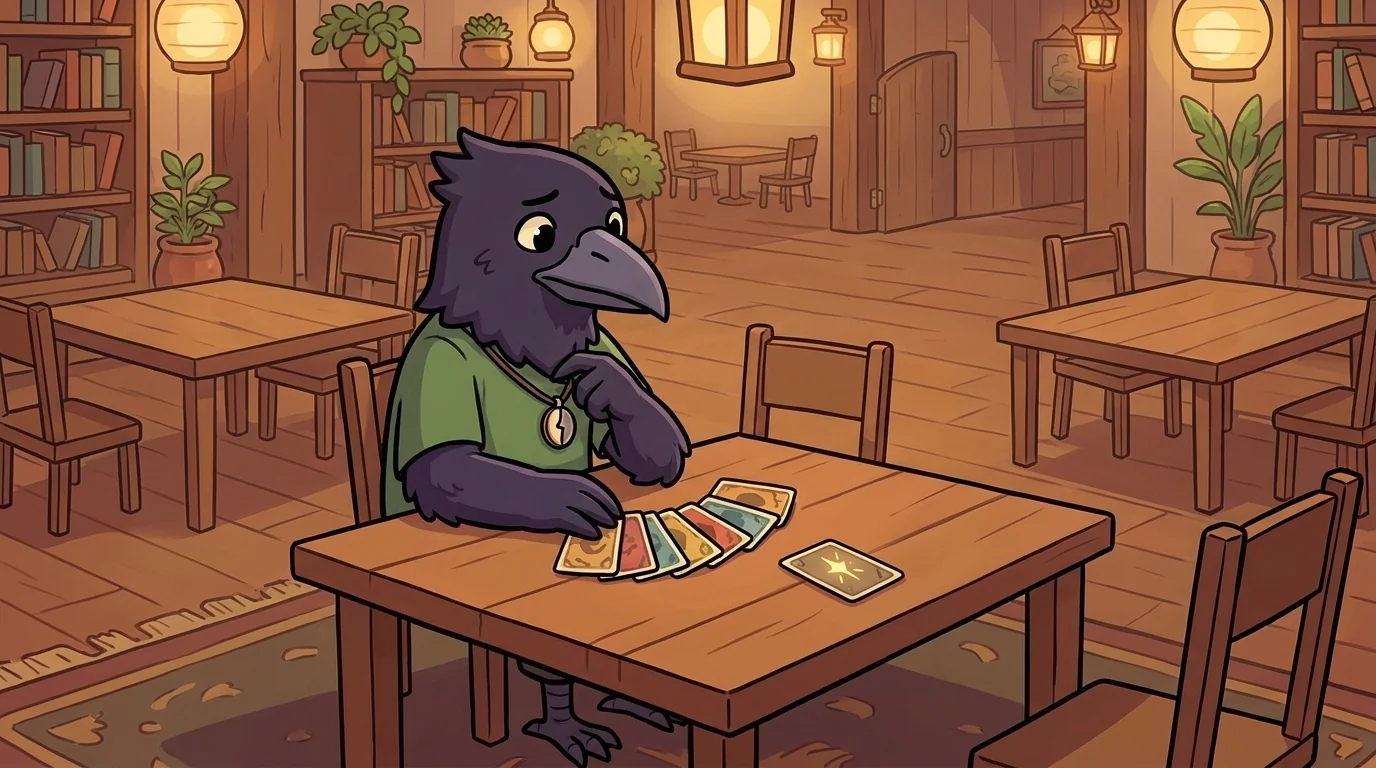
Later, when the hall had emptied out, the boy came back with one more question. He was quieter now.
"When you can't see her cards," he said, "and you can't talk, and all you've got is one little bid... how do you ever trust that you're hearing her right?"
Bram thought about the roost. About the puffed-up sulk, and the hot tight shut-the-door feeling, and his grandmother's slow question that had cracked him open.
"You listen like she's a friend who finally worked up the nerve to say what she means," Bram said. "And you decide — before the hand even starts — that she's on your side. That every bid she makes is her reaching toward you, not against you." He touched the locket at his throat. "When you believe that, something loosens in you. You stop bracing. You stop defending. You just... lean in and hear her. And when you get it right — when her message lands and you play it together and it works — there's this feeling."
"What feeling?"
Bram was quiet a moment, searching for it.
"Like being understood," he said finally, "by someone who was never going to say it in words. Warm, right in the middle of your chest. Like you're not playing alone anymore." He looked toward the door where Whisp had gone. "That's the thing I'd carry out of here, if you only take one. Not the cards. The feeling of being heard — and of finally knowing how to hear somebody back."
The boy nodded, slow and thoughtful, and Bram watched the last of the fume go out of his shoulders — the same warm, unclenched way his own had, years ago, on a roost he'd never quite stopped thinking about.
The DealTales ensemble
Bram is part of DealTales's distributed-narrative cast. Each character embodies a different curricular primitive; together they teach the full subject.