
Parity
PARITY — *some knots only show up on the big cubes. they have their own key.*
Press play to listen along. The line being read lights up as you go.
Show full transcript
Loading transcript…
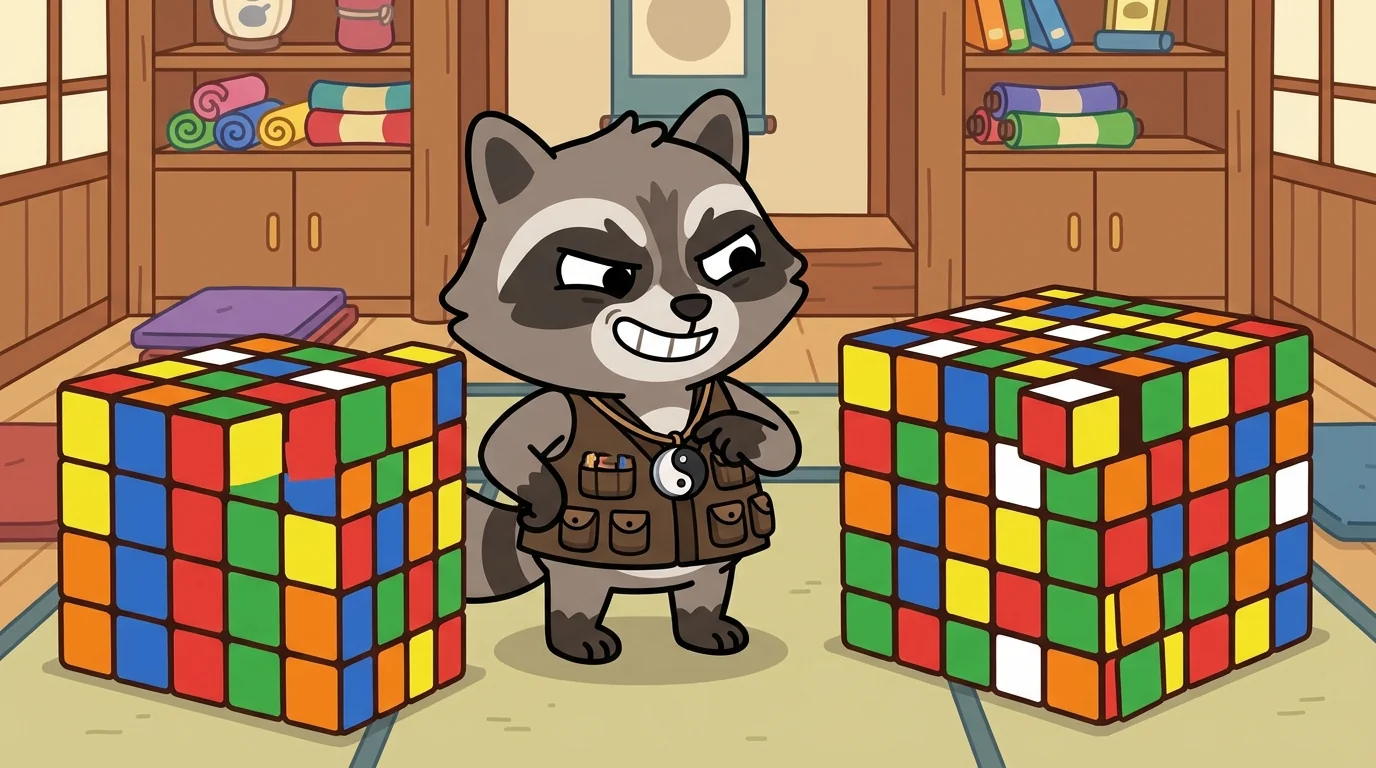
Parity sat on a low wooden bench in the quietest corner of the Academy. Her dojo vest was a faded navy, stiff with salt stains and stuffed with small tools. In one pocket, she kept a brass tensioning screwdriver; in another, a tiny vial of silicone lube. From a thin leather cord around her neck hung a single circular charm. It was split down the middle, one half charcoal black and the other chalky white.
Most of the students preferred the standard three-by-three cubes, which clicked with a light, predictable rhythm. Parity, however, liked the heavy ones. She spent her afternoons near the four-by-fours and five-by-fives, cubes that felt like thick bricks in a kid's hands. These bigger puzzles had a deeper, throatier sound when you turned their faces, clacking together like heavy river stones.
Parity watched the students solve them, waiting for the moment when the ordinary rules simply stopped working. She was looking for *parity*, the strange state that could never exist on a normal cube.
"On the little cubes, every knot untangles if you just follow the path," she said. She tapped her split charm against her collarbone, listening to the quiet click of metal against bone. "But when you add more layers, the math of the puzzle changes completely. Sometimes you get a knot that the standard road cannot touch." She smiled, her lopsided grin showing a chipped left tooth. "Two edges swapped, or one single piece flipped—that is my territory."
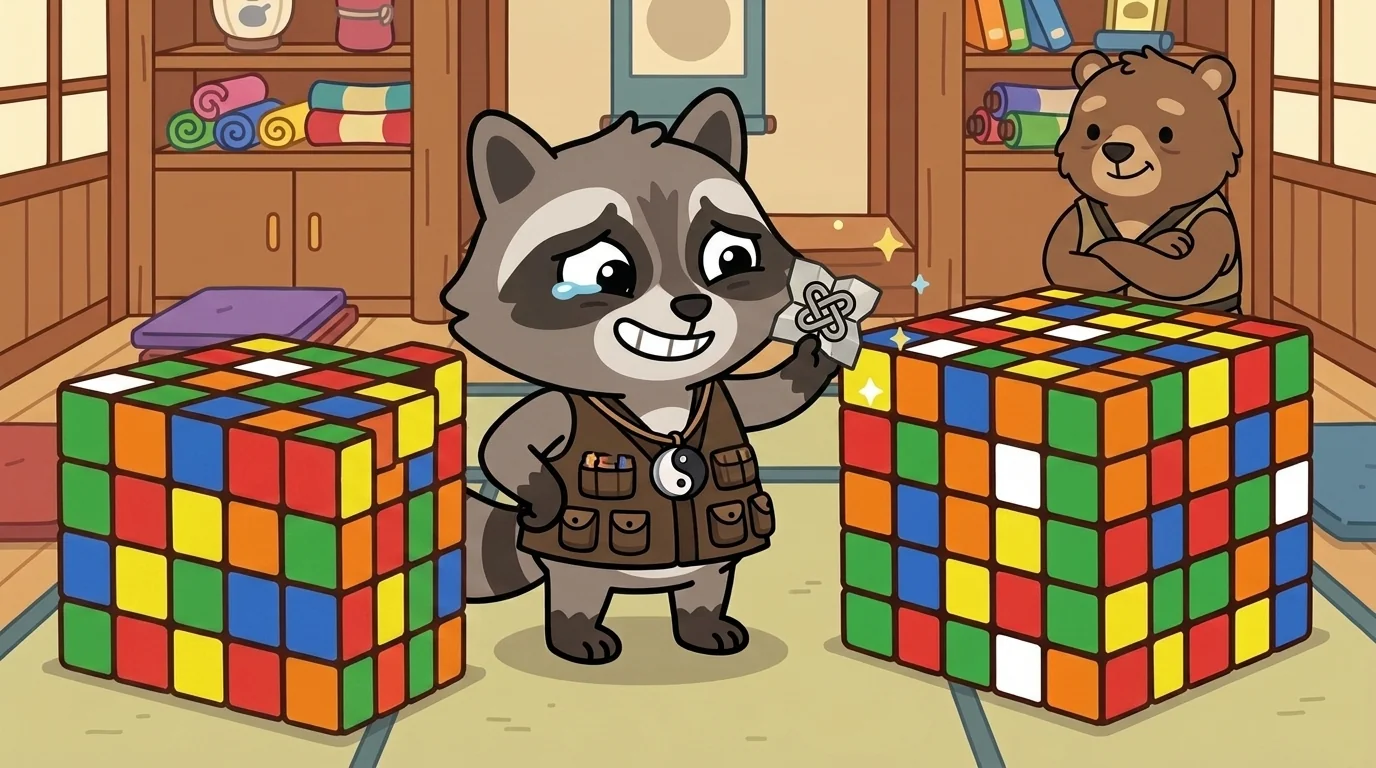
She had learned about this boundary the hard way, years ago, during her first winter tournament in a drafty gym. The air in the cavernous room had smelled of damp wool coats, floor wax, and nervous sweat. Parity had been twelve then, her fingers small and quick on the slick plastic of a brand-new 4x4. She had worked through the steps with extreme care, matching the colored centers and pairing the edges.
Then, with only three turns left to finish, she hit a wall that made no sense. Two edge pieces were swapped, but everything else on the cube was perfectly aligned. She tried a standard T-perm, then a J-perm, but each attempt only scrambled the puzzle further. Her stomach tightened into a cold, hard knot of pure frustration. She was absolutely sure she had ruined the entire solve fifty moves earlier. She sat there, blinking back hot tears, ready to toss the plastic block into her backpack.
An old coach named Vance sat down on the wooden bench beside her, holding a warm mug. He smelled of peppermint tea and old paper, and he did not reach for her cube. He did not tell her she had messed up, either, which only made her feel more confused.
"You didn't make a mistake, kiddo," Vance said, pointing a blunt finger at the swapped edges. "This is a real thing, and it only happens because the big cubes have an even number of pieces." He took a stubby pencil and drew a quick, sharp diagram on the edge of his napkin. "The middle behaves differently when there is no single center tile to anchor the turn." He showed her a sequence of seventeen moves—the *parity algorithm*—and the impossible knot suddenly fell open.
"See?" Vance said, packing up his tea with a quiet chuckle. "Not a mistake, kiddo. Just a case with its own key."
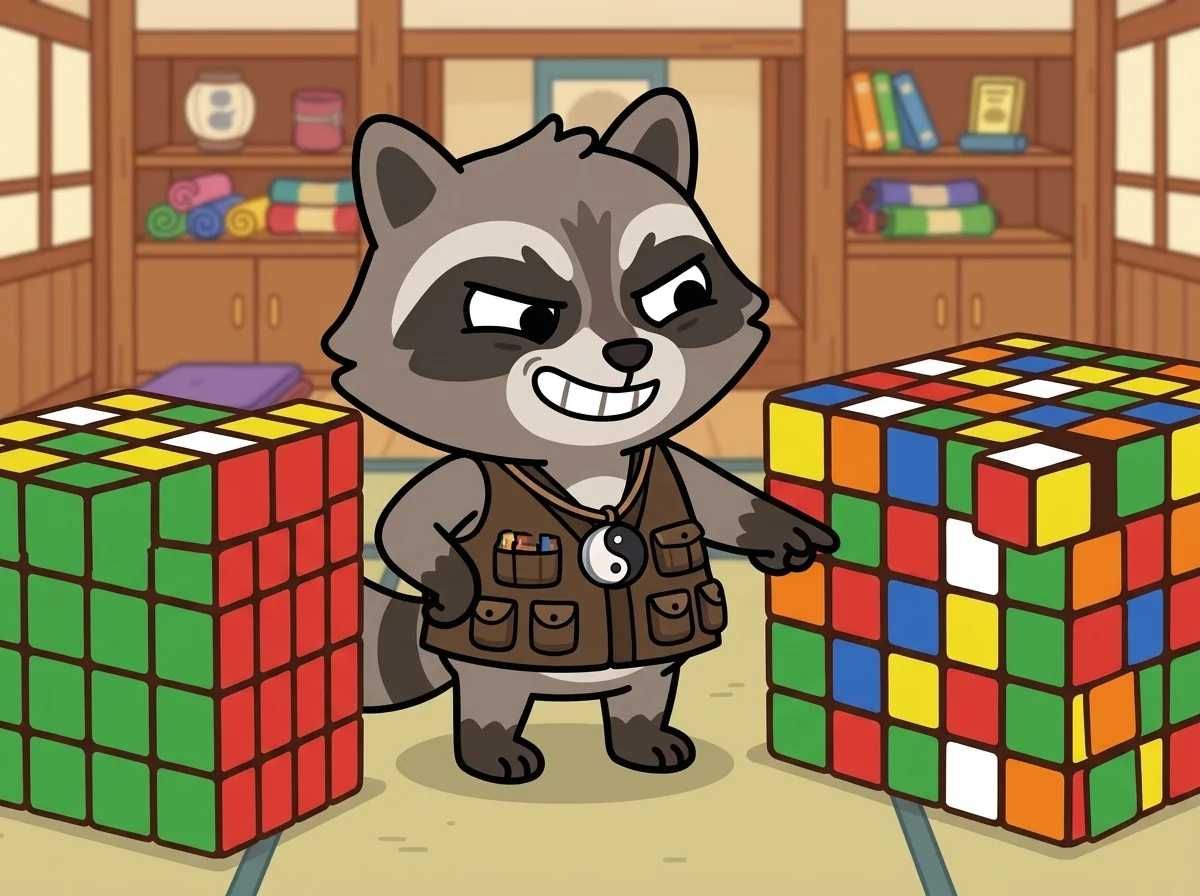
At the Academy, the other instructors taught the reliable roads that worked every single time. Cross showed students how to lay the white cross on the bottom face with perfect precision. Layer built the puzzle from the ground up, slotting each corner piece into its proper home. Look kept his eyes ahead, scanning for the next move before the current one even finished. Their methods were beautiful, reliable, and perfectly suited for the standard three-by-three cube.
But Parity's job was entirely different from theirs. She was the one they called when the reliable road suddenly ran into a dead end. Sometimes a big-cube solve reached the very end and left behind a state that looked broken. It looked like a terrible mistake that no ordinary move could ever hope to fix.
In those moments, Parity would trundle over, tilt her split charm, and offer a quiet reassurance. "That's not a mistake," she would say, her voice steady and calm. "That's parity, and it has its own key." She did not judge the students for their sudden panic when the cube refused to solve. Instead, she showed them that the rules of the small world did not always apply to the large one.
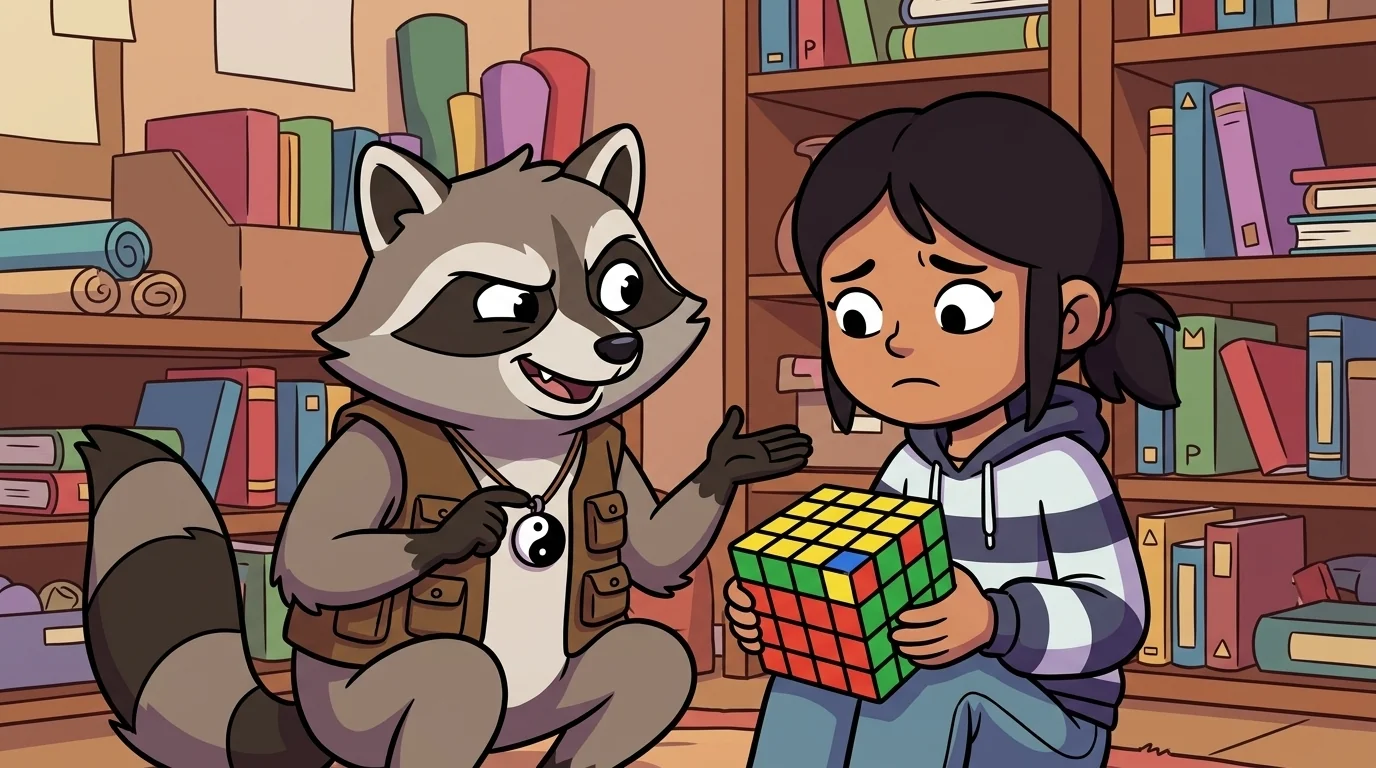
A cuber named Mira sat on the concrete steps with a heavy five-by-five cube in her lap. Her fingers were smudged with gray plastic dust, and her face was flushed with pure misery.
"I'm so close," Mira whispered, her voice cracking slightly as she turned the top face. "But look at this—one single edge is flipped upside down, and it makes no sense. On the smaller cubes, a single flipped edge like this is completely impossible to achieve." Her shoulders slumped heavily, and she stared down at the offending red-and-yellow block. "I must have messed up the whole thing fifty moves ago," she said, her eyes welling with tears. "I should probably just scramble the entire puzzle and start over from the very beginning."
"Don't scramble it," Parity said quickly, crouching down on the dusty step beside her. "Take a deep breath and look closely at the rest of the cube. Is everything else solved, or is there another mistake hidden somewhere in the layers?"
Mira nodded miserably, wiping her nose with the back of her sleeve. "Yes, the corners are perfect, and all the other edges are in their proper places."
"Then you didn't mess up at all," Parity said, her voice warm and reassuring. "This is a known case, and it has its own special name. On the big cubes, because of how the pieces pair up, you can end with one edge flipped alone. On a three-by-three, the math simply won't allow this state to happen. But your cube has more pieces, so the physical rules of the puzzle are different. It's not your fault; it's just the natural result of the cube being big."
Mira stared at her, her brow furrowed in deep disbelief as she processed the words. "So... it's supposed to look completely impossible to me?"
"It's supposed to look impossible to the ordinary tricks," Parity said with a lopsided grin. "Which is exactly why it gets its own special sequence of moves to resolve it." She reached out and gently tapped the side of Mira's heavy, dusty cube. "Let's walk through the parity algorithm together, nice and slow, one step at a time."
Mira hesitated, her hands shaking slightly as she gripped the cold, heavy plastic. She still half-believed she was about to ruin the entire puzzle with one wrong turn of her wrist.
"Right face clockwise," Parity instructed, keeping her voice steady and rhythmic. "Now turn the back face twice, and then the up face twice. Left face counter-clockwise, and then the up face twice again."
With each turn, the heavy plastic clicked sharply in the quiet, dusty stairwell. Mira's fingers grew surer as she followed the strange, winding pattern of moves. It felt entirely different from the standard algorithms she had memorized so carefully before. But when the final turn landed with a solid snap, the flipped edge rolled into place. Suddenly, the entire five-by-five was perfectly solved, its solid colors gleaming in the dim light.
Mira let out a long, shaky breath she had been holding for minutes. "It just... needed a different key," she whispered, tracing the smooth plastic.
"Exactly," Parity said, standing up and brushing the gray plastic dust from her knees. "Some knots aren't harder; they're just a different kind. And a different kind of knot always needs a different kind of answer."
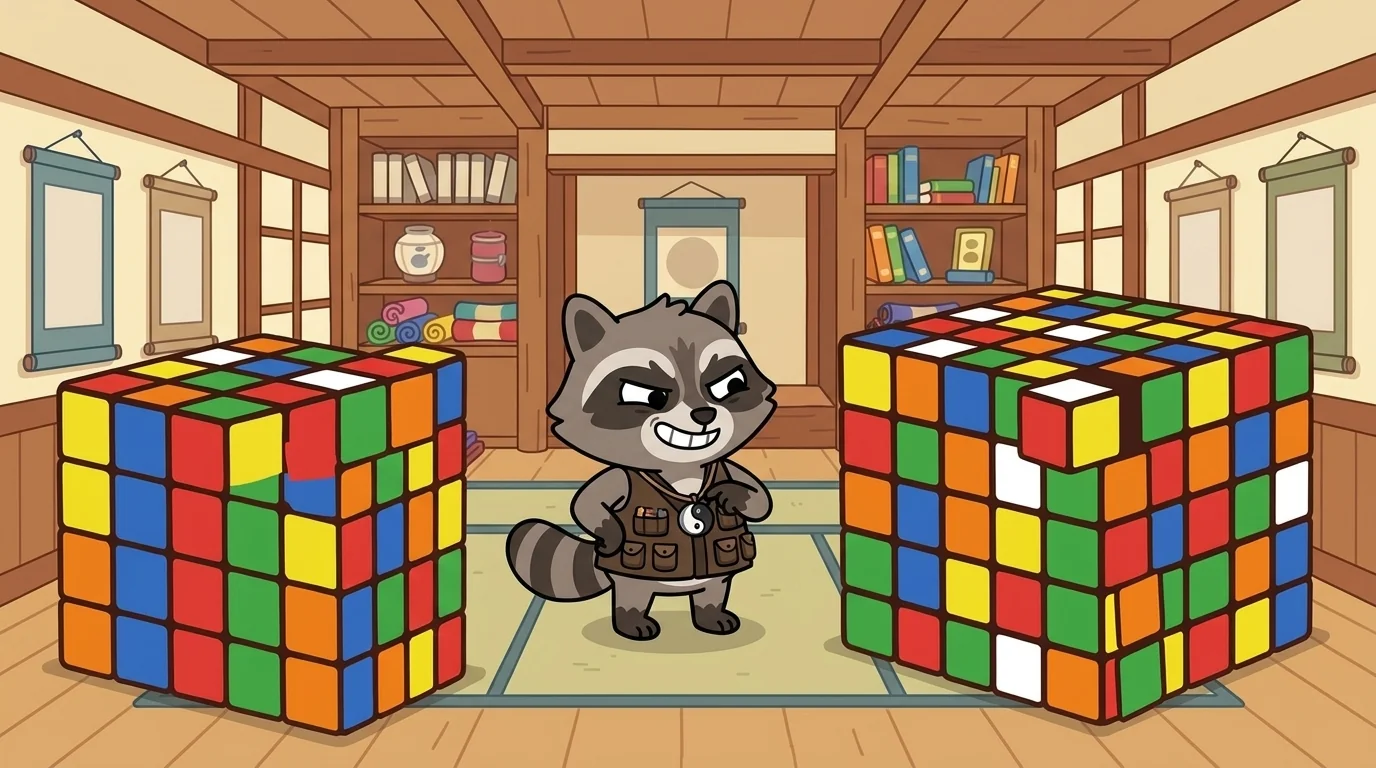
That night, Mira kept the solved five-by-five on her desk where she could see it. The desk lamp cast a warm, golden glow over the perfectly aligned colored squares. Earlier, the sight of that flipped edge had made her stomach drop with a familiar dread. It was that sick, sinking certainty that she had ruined everything through her own carelessness.
Now, looking at the perfect cube, she felt something looser and warmer instead. She felt the quiet relief of learning that "impossible" had only meant "unfamiliar" all along. She ran her thumb over the smooth, seamless edge of the plastic puzzle. The next time something looked broken beyond repair, she would not immediately blame her own hands. She would not scramble her progress and start over from the very beginning. Instead, she would lean in, tilt her head like Parity, and look for the key.
The CubeSensei ensemble
Parity is part of CubeSensei's distributed-narrative cast. Each character embodies a different curricular primitive; together they teach the full subject.
-
Layer
Beginner method — layer-by-layer steward; 'Bottom first. Always.'
-

Cross
CFOP method — speedcubing steward; 'Cross, F2L, OLL, PLL — that's the road.'
-
Block
Roux method — block-building steward; 'Build the blocks. Skip the cross.'
-
Edge
ZZ method — edge-orientation steward; 'Orient first. Then everything's faster.'
-
Pair
Ortega method — 2x2 specialist; 'Two-by-two has its own rules.'
-

Look
Cross-method look-ahead coordinator; 'Eyes ahead. Hands following.'
-
Chart
Lessons-layer cast (inspection planner — the fifteen-second pre-solve read)