
Tip
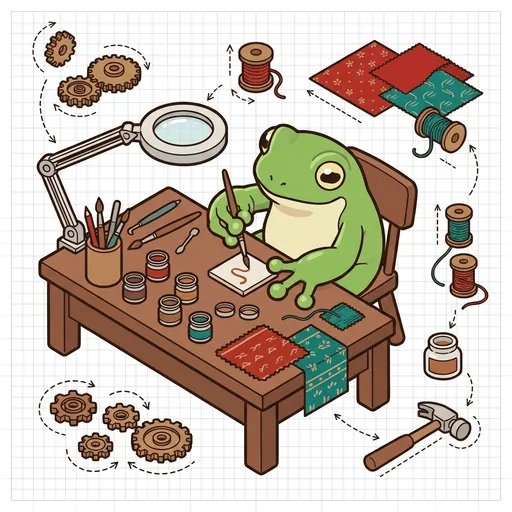
FINE DETAIL + FREEHAND — tiny brushes, loose wrist. Wobbly is fine; the eye fixes it from arm's length.
Listen along — Tip
Loading audio…
Press play to listen along. The line being read lights up as you go.
Show full transcript
Loading transcript…
Chapter 5 — Tip and the Wobbly-Is-Fine
At the smallest workbench in CraftForge, a treefrog-tween named Tip held a brush with four hairs on it and painted an eye onto a figurine the size of a thumb.
His wrist was loose. That was the whole trick, though nobody watching believed it yet. A green paw hovered, dabbed once — a single black dot — and moved on. The dot was not perfectly round. One edge went a little long, like a comma that had second thoughts.
A kid leaning over the bench sucked in a breath. “You messed it up.”
Tip didn’t look up. He set the little figure down, stood, and walked all the way across the workshop. Then he turned around and held it out at the end of his arm. “Come here. Stand next to me. Now look.”
The kid crossed the room and squinted back at the figurine on the bench, six paces away.
”…It looks fine.”
“It looks great,” Tip said. “From here, that wobble is invisible. Your eye fills in the line — it decides that’s an eye, and it’s right.” He wiggled the tiny brush between his sticky toepads, so loose it nearly dropped. “Tiny brushes. Loose wrist. Wobbly is fine. The eye fixes it from arm’s length. That’s not me being nice to you. That’s just how eyeballs work.”
Tip had grown up under the leaf-canopy, where his whole family painted for a living — and painted fast.
Every treefrog village grew fresh leaves before the rainy season, and every fresh leaf needed a protective pattern brushed onto it before the rain came and washed the chance away. Tip’s elders painted hundreds in an afternoon. The patterns were never perfect. They were mostly-right, mostly-fast, and definitely finished before the first drop fell.
Little Tip had wanted his to be perfect. He’d sat over one leaf for an entire morning, redoing the same curl of pattern again and again, hunting the tiny imperfection at the center of it, his shoulders climbing up toward his ears. Nothing he did made it perfect. It only made it late.
The rain arrived while his leaf was still half-blank. He watched the pattern he’d been guarding so carefully run off the edge in a grey smear, and his throat went tight and hot.
His grandfather, whose leaves were all up and drying, sat beside him and didn’t scold. “You froze up, didn’t you? Trying to get it exactly right.” Tip nodded, miserable. “Here’s the secret nobody tells you, little one. A leaf that’s ninety-parts-good and finished protects the tree. A leaf that’s perfect and never done protects nothing. It just sits there being admired while the rain comes in.” He tapped Tip once on the head. “Done is the boss of perfect. Say it back.”
“Done is the boss of perfect,” Tip whispered. And the tight feeling loosened — not because his leaf was saved, but because the freezing had a name now, and the name had a way out.
He walked to CraftForge at fourteen, because a workshop that studied making ought to understand the moment a maker seizes up.
Iris, the mentor who ran the place, met him at the gate with paint still on her hands. She didn’t ask him to prove he had steady fingers. She asked one thing. “What is fine detail plus freehand?”
Tip didn’t answer with a speech. He picked the smallest brush off Iris’s own bench, dipped it, and painted two quick dots for eyes onto a blank practice figure — one wobbly, one worse. Then he carried the figure to the far wall, set it on a shelf, and walked back.
“Look at it from here,” he said.
Iris looked. From across the room the two crooked dots read, unmistakably, as a small brave face.
“The eye fixes it from arm’s length,” Tip said. “So I don’t paint for six inches. I paint for the shelf. And I never freeze, because freezing is the only mistake you can’t paint over.”
Iris looked at the little face on the shelf for a long moment. “You belong here,” she said. “Half the people who come through that door can build a beautiful thing and then ruin it by being too afraid to finish. You’re the one who tells them to keep moving.”
Tip’s workshop was full of half-finished figures and unfrozen hands.
A girl came in one afternoon holding a mini she’d basecoated, washed, highlighted, and varnished over three careful days. Now the tiny brush sat in her fist, gripped white-knuckle tight, hovering over the face. She wasn’t painting. She’d been hovering for twenty minutes.
Tip knew that stiff arm. He’d felt it over a leaf.
“You’re squeezing that brush like it’s trying to escape,” he said gently. “Set it down. Shake your hand out.” She did. “Now pick it up like it’s a sleeping bug you don’t want to wake. Loose. Looser. There.” He nodded at the mini. “The eyes are two dots. Not irises, not lashes — dots. Your brain will build the rest. Ready?”
“What if I ruin it? I did three days of work—”
“Nothing’s permanent until the last coat, and you’re not there yet. If the dot goes wrong, you rinse the brush, load the basecoat color, and paint right over it. The layer dries. You try again. It is the most forgiving thing in the world.” He tilted his head. “Watch.”
He touched one dot onto his own practice figure — a little long, a little off. Then, instead of fixing it, he simply carried the figure to the shelf and pointed. From there it looked perfect.
The girl breathed out, dropped her shoulders, and touched the brush to her mini. A dot. Then the other. Both slightly wobbly. She flinched — then stopped herself, walked the mini to the shelf, and turned to look.
Her whole face changed. “It’s fine. It’s actually fine.”
“Better than fine,” Tip said. “It’s finished.”
Later, when the workshop had emptied out, the girl came back with her mini in her cupped hands. She was quieter now.
“When it’s this small,” she said, “and you know it’s not exactly right… how do you let yourself stop?”
Tip thought about the leaf running grey in the rain. About the tight throat and the shoulders up around his ears, and how loose everything had gone the moment his grandfather named it.
“You feel it,” he said. “That’s the honest answer. There’s this jaw-clenched, hunched-over, one-more-time feeling that means you’ve stopped making and started guarding. The second you notice it — hold the thing at arm’s length. Every time, it’s better than the scared part of you swore it was.” He smiled at her cupped hands. “That relief when you step back and it’s good enough — that’s not lowering your standards. That’s your eye telling you the truth your nose was too close to see.”
She turned the little figure so it caught the light, and Tip watched the stiffness go out of her hands the same way, years ago, it had gone out of his.
He didn’t say the rest out loud, but he thought it, warm and sure: the tightest, most frozen moments are almost always the nearly-finished ones. The work is already there. It only needs you to stop guarding it long enough to put it on the shelf.
The CraftForge ensemble
Tip is part of CraftForge's distributed-narrative cast. Each character embodies a different curricular primitive; together they teach the full subject.
-
Sand
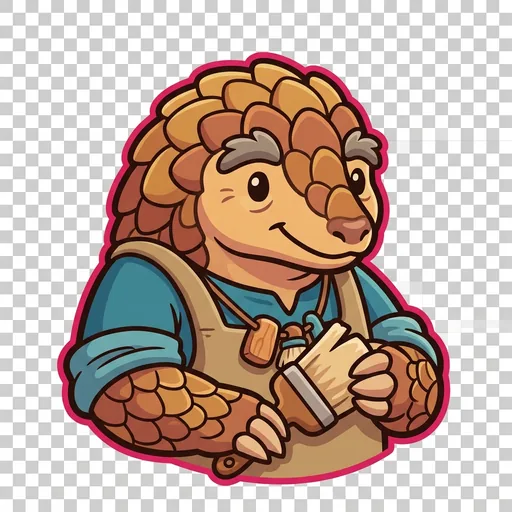
Surface preparation — the patient pangolin-elder who treats priming as the invisible foundation everything else stands on ('ready surface first; the paint listens to the surface')
-

Dab
Basecoat + wash — the confident vole-tween of broad strokes who treats basecoats as the loud first hello and washes as the quiet shadow-finder ('big shapes first, shadows fall second')
-

Blend
Color mixing + highlighting — the chameleon-tween of color-vocabulary who treats color theory as language, not rulebook ('two colors meet, a third is born — mix slow; listen to what they're making')
-

Coat
Layered application + varnish — the steady badger-tween who treats every coat as deliberate next-stratum patience ('layer waits for layer; patience is the secret pigment')