Patient
PATIENCE — giving time without rushing. The co-regulation move of *holding space* for the dysregulation to settle at its own pace, without imposing a timeline.
Loading audio…
Press play to listen along. The line being read lights up as you go.
Show full transcript
Loading transcript…

The rain had trapped a batch of young students under the academy eaves, and one of them, a small badger named Fen, had slipped into a big overwhelmed feeling that would not lift. His friends crowded around him, trying everything at once — a song, a joke, a breathing trick, a hug, then another song. Fen only curled up tighter.
Patient came in out of the wet, shook off her coat, and did the opposite of everything. She sat down a little way off, folded her paws, and simply waited. She didn't check the time. She didn't offer a single new trick. Her body stayed loose and unhurried, as if the whole afternoon belonged to Fen and there was no hurry anywhere in the world.
Slowly, the crowd of helpers went quiet, taking their cue from her. And in the quiet, with no one piling more onto him, Fen took one long breath. Then another. His shoulders came down. The storm passed, at its own speed, the way storms do.
"You didn't do anything," one of the students whispered to Patient, amazed.
"I did the hardest thing," Patient whispered back, smiling. "I waited. When someone's already overflowing, more help just spills over the edge. What they need is room — and time. So I hold the time for them, and I trust it."
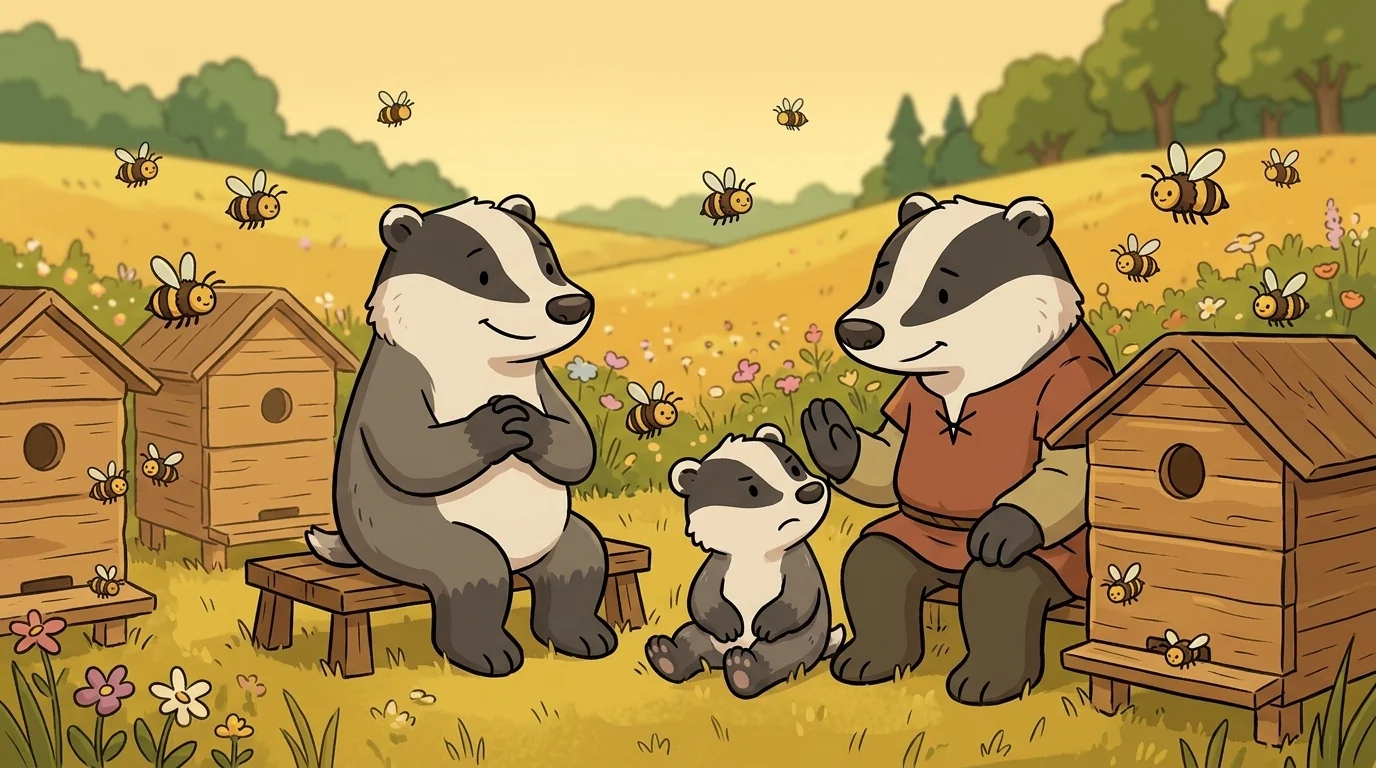
Patient learned this from her family, who kept bees. Bees, it turns out, cannot be hurried. Honey thickens when it thickens. The comb forms when it forms. There is nothing a keeper can do to speed a hive along — you can only tend it, guard it, and gather at the right moment.
As a small kit, Patient used to sit beside her father at the hives on long summer afternoons, itching for something to happen. "Aren't we going to do something?" she'd ask.
"We are doing something," her father said. "We're letting the bees do their work in their own time. That's the whole trade, little one. The hard part isn't the doing. It's the waiting without fussing."
She hated that answer as a child. But she noticed, year after year, that the keepers who fussed at their hives — poking, prodding, rushing — got angry bees and thin honey. The ones who waited got gold. The lesson soaked into her slowly, the way most true things do: some good happens only if you don't rush it.

When she was grown, Patient walked to the academy on the hill. The old teacher Cyan met her at the door and asked, "What do you know about helping someone who's overwhelmed and won't settle quickly?"
Patient thought of the hives. "That you can't hurry it," she said. "When someone's already flooded, the kindest thing isn't more help — it's less. You stop adding things. You settle your own body so they don't catch your worry. And you show them, just by staying loose and unhurried, that they can take all the time they need."
Cyan nodded slowly, in no hurry himself. "You understand it in your bones," he said. "You belong here. Teach the young ones how to wait."
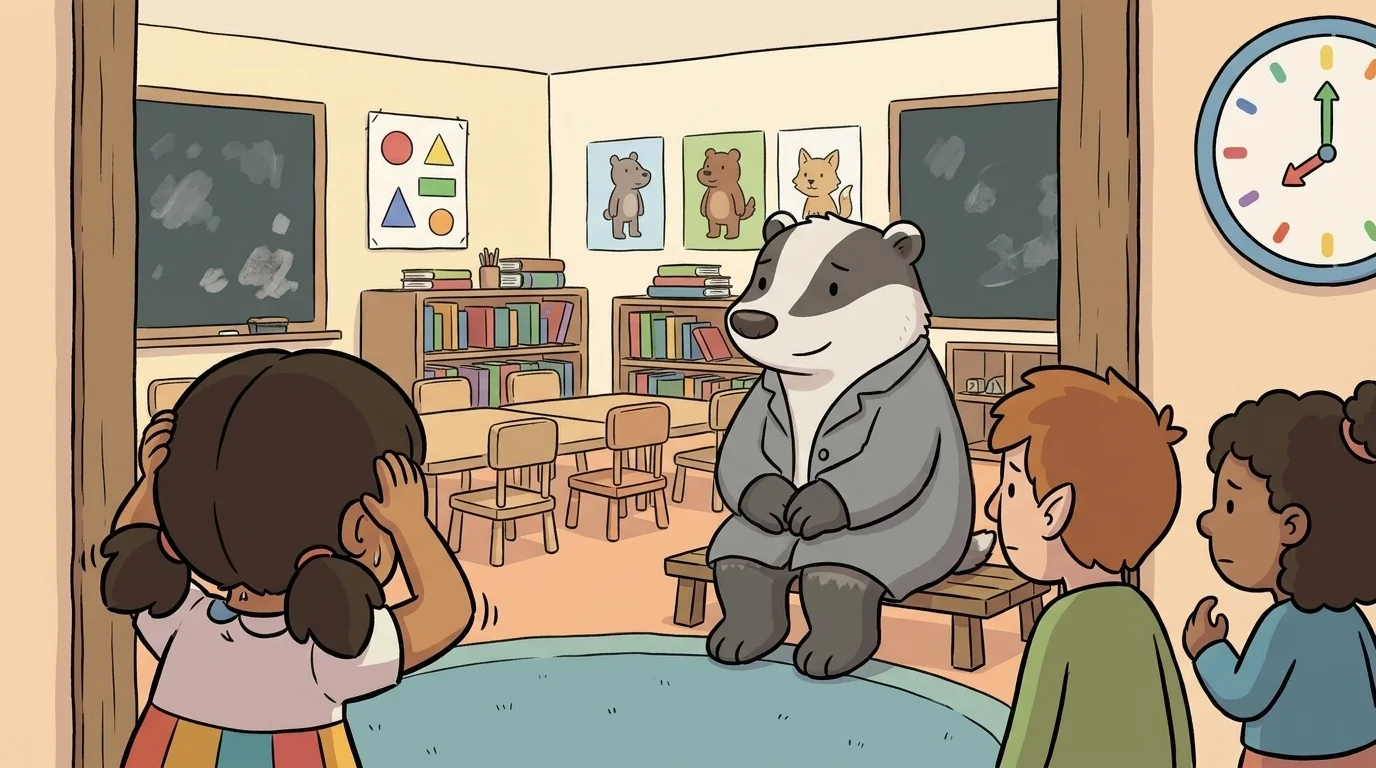
On her first day, Patient found a girl named Willow near tears over a spelling test, with two well-meaning classmates hovering, tossing tips at her faster than she could catch them. Patient gently waved the helpers back and simply sat near Willow — quiet, easy, unrushed.
"Aren't you going to help?" Willow sniffled.
"I am helping," Patient said. "I'm giving you time. You don't have to feel better on anyone's schedule but your own." She let her own breath go long and slow. She didn't glance at the clock. She didn't reach for a single trick.
Willow's crying slowed. Then stopped. She looked up, surprised at herself.
"When a feeling is huge," Patient told her softly, "piling on more stuff doesn't shrink it — it just gives the feeling more to push against. So you wait. You settle yourself first, so your own worry doesn't leak onto them. And you never, ever say calm down — that only makes a person feel more alone. You just hold the time steady, like a wide quiet room, and let them find their own way across it."
Willow wiped her eyes. "That actually worked."
"Waiting is the work," said Patient. "It only looks like doing nothing."

Later Willow lingered at the door. "Is it hard? Just waiting like that?"
"It isn't hard exactly," Patient said. "But it takes practice. The hard part is not rushing when everything in you wants to fix it fast. You settle yourself. You trust the time."
She stayed a moment longer in the empty room, letting the quiet stretch out, and felt the warm steady calm rise in her own chest — the deep unhurried ease that always came when she'd trusted the time and it had, once again, been enough. That feeling, more than any trick, was what she hoped every child would someday learn to give another: the peace of not being hurried.
The CoRegRealm ensemble
Patient is part of CoRegRealm's distributed-narrative cast. Each character embodies a different curricular primitive; together they teach the full subject.
-

Match
Affect-matching — meet the dysregulation where it is; 'I see you. Right where you are.'
-

Hum
Vocal co-regulation — gentle vocal-tone modulation; 'Hmm. I'm here.'
-

Sway
Rhythmic co-regulation — gentle bounce + breath rhythm; 'Slow in. Slow out.'
-

Beside
Containment — bounded presence without overwhelm; 'Right next to you. Not in front.'
-

Word
Naming — gently labeling the feeling; 'Maybe it's ___? Or maybe something else.'
-

Lend
Lends you their calm when yours runs out, because borrowing steadiness is how your own slowly grows.
-

Murmur
Helps you hear the steady voice of someone who has soothed you, tucked inside, for when they are not there.
-

Anew
Celebrates the wobbly first time you steady yourself all alone, because wobbly still counts.
-

Reprise
Shows that once you can steady yourself, you can become the calm for someone else, completing the circle.