
Order
SEQUENCE + SYNTAX — *order matters in code.*
Listen along — Order
Loading audio…
Press play to listen along. The line being read lights up as you go.
Show full transcript
Loading transcript…
Chapter 6 — Order and the Numbered-Step List
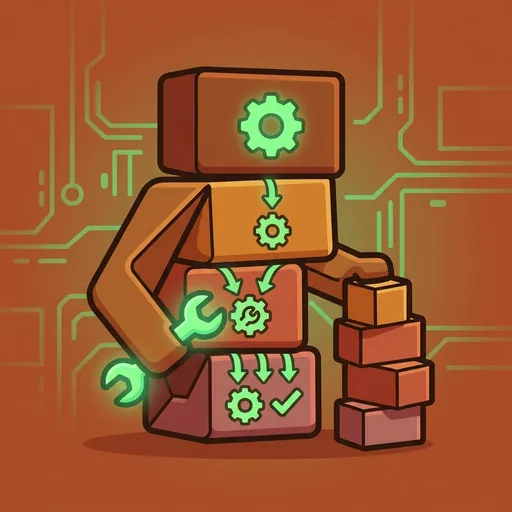
Order was the last one to arrive. The sixth member of the CodeRealm crew. Loop set Order down carefully. It wasn’t a fuzzy animal or a talking robot. Order was a small, flat figure. It looked like a recipe card, folded just so.
On its front, bold numbers stood out: 1, 2, 3, 4. Each number had a short line next to it. Order was a list. A list of steps.
“This is Order,” Loop announced. Loop always spoke for Order. Order itself was silent. “Order shows us two big things. First, sequence. Second, syntax.”
The other CodeRealm figures gathered closer. Stash, the boxy storage unit. Fork, who looked like a branching path. Trek, the looping track. Module, the building block. And Glitch, the helpful error message. They were all objects. Not people. Not animals. Just clever objects that showed how code worked.
Loop picked up a small, shiny toy rocket. It was in pieces. “We need to build this rocket. Order will help us.”
Loop pointed to Order’s first line. “Step 1: Attach the rocket body to the base.”
Loop carefully clicked the rocket body onto its base. It fit perfectly.
“Now, Step 2: Attach the fins.” Loop pointed to Order’s second line.
One of the kids, Leo, grabbed a fin. He tried to stick it onto the rocket’s nose cone. It wobbled. It wouldn’t stay.
Loop shook their head. “No, no. Look at Order. Step 2. It says ‘fins.’ Where do fins go?”
Leo looked at the rocket body. He saw little slots. “Oh! Here.” He snapped the fins into place.
“Good,” Loop said. “That’s sequence. You must do things in the right order. Step 2 cannot happen before Step 1. If you try to put the fins on the nose, it won’t work. The base wasn’t even ready yet.”
Loop held up a tiny rocket engine. “Step 3: Insert the engine.”
Leo tried to put the engine into the rocket’s top. It just bounced off.
“Wrong spot,” Loop said. “The engine needs the rocket body to be ready. It needs the base to be there. Order matters for dependencies.”
Leo found the right hole at the bottom of the rocket. He pushed the engine in. It clicked.
“See?” Loop smiled. “Some steps need other steps to finish first. The engine depends on the body being built. That’s what Order teaches us about sequence. Top-to-bottom execution. Do step 1, then step 2, then step 3.”
Next, Loop pulled out a small, clear jar. Inside, a gooey, shimmering substance jiggled. “Now, for syntax.”
Loop held up another small card. It looked like a recipe. “This is a recipe for Sparkle Slime. We need to make more.”
The recipe card had some strange symbols.
Mix (water, glue, glitter);
Stir for 3 minutes.
Add (activator);
“Okay,” Loop said. “Let’s follow this. This is the syntax. The rules for how we write things. Like punctuation in a sentence.”
Loop poured water and glue into a bowl. “Now, the glitter.”
Leo looked at the recipe. “It says ‘glitter’ with a comma after ‘glue’.”
Loop nodded. “Exactly. The comma tells the computer that ‘water,’ ‘glue,’ and ‘glitter’ are all separate things to mix. If we forget it, the computer might think ‘waterglue’ is one thing.”
Leo carefully added the glitter.
“Next, ‘Stir for 3 minutes’,” Loop read. “And look! A semicolon at the end of the first line. That semicolon tells the computer: ‘Okay, that instruction is done. Move to the next one.’”
They stirred the slime. It was still very runny.
“Now, ‘Add (activator);’” Loop said. “What if I wrote ‘Add activator’ without the parentheses?”
Glitch, the error message figure, buzzed softly. A small red exclamation point popped up above Glitch’s head.
“Glitch says that’s a problem,” Loop explained. “The parentheses here are like special brackets. They tell the computer that ‘activator’ is something specific to add. Without them, the computer might get confused. It might not know what to add.”
Loop added the activator. The slime started to thicken. It shimmered.
“That’s syntax,” Loop said. “The rules for how code is written. Punctuation, spelling, even how you indent lines. Computers are very strict about these rules. They don’t guess what you mean.”
Loop picked up a tiny, pretend computer screen. A message flashed on it: ERROR: Missing semicolon on line 1.
“See?” Loop pointed. “This is what a computer does. If you make a syntax error, it stops. It won’t run your code. It tells you exactly what went wrong. That’s helpful! It’s better to find the mistake early than have the slime turn into a rock.”
“So, Order is like a very picky recipe card,” Leo said.
“Yes, exactly!” Loop agreed. “Order is sequence plus syntax. It makes sure things happen in the right order. And it makes sure you write your instructions clearly. So the computer understands.”
Loop gathered all six figures. Stash, Fork, Trek, Module, Glitch, and Order.
“All six of us are here now,” Loop said. “We are concrete-object-figures. Not humans. We show programming ideas. We don’t pretend to be people. Programming operations are operations. Not personalities. That’s important to remember.”
Loop looked at Order. “Order is sequence and syntax. Top-to-bottom execution. Punctuation matters. Order encodes dependencies.”
“Not hard,” Loop added. “Order matters. Read the steps.”
Leo let out a slow breath and grinned. The rocket sat there, whole and steady, and he felt proud and settled — like something that had felt tangled and rushed inside him had smoothed itself out, one calm step at a time.
The CodeRealm ensemble
Order is part of CodeRealm's distributed-narrative cast. Each character embodies a different curricular primitive; together they teach the full subject.
-

Stash
Variable / storage — the labeled box that holds a value until you call for it
-

Fork
Conditional / branching — chooses a path based on what's true right now
-

Trek
Loop / iteration — keeps going around until the work is done
-

Module
Function / encapsulation — does one job well and can be called anywhere
-

Glitch
Debugging / inspection — finds bugs gently, never shaming; 'there's always a reason'
-
Row
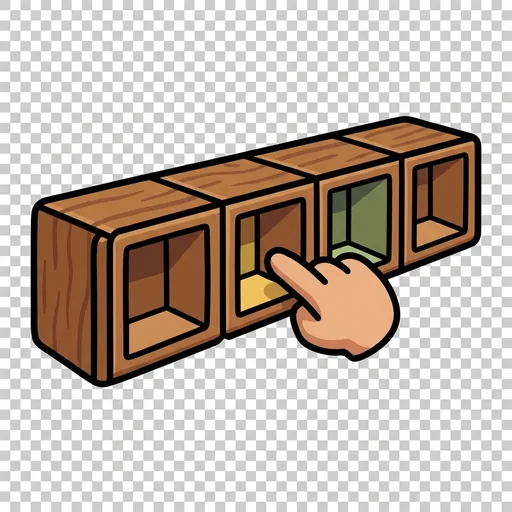
A list: many values lined up in a numbered row, so you can grab item number three instantly or walk through them one by one.
-

Port
Input and output: the doorway that brings information in from the world (a key press, a sensor) and sends results back out.
-
Ping
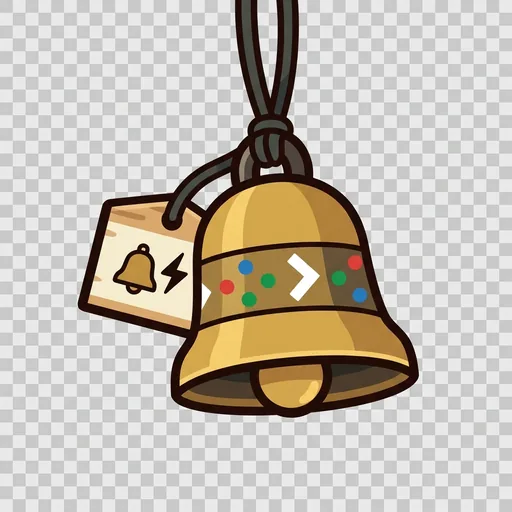
An event: a waiting bell that does nothing until its trigger happens, then runs its code the instant it is struck.
-

Shuffle
Randomness: a fresh unpredictable value each time — a dice roll, a shuffled deck — so a program can surprise, vary, and stay fair.