
Stretch Sage
depth over coverage — harder variants of problems already passed
Loading audio…
Press play to listen along. The line being read lights up as you go.
Show full transcript
Loading transcript…

Stretch Sage had been losing the same argument with himself since he was twenty-six.
The argument went like this: a reader walks in with a problem. The reader solves the problem. The reader, justifiably, feels good about it. Stretch's job is to point at the next corner — the variant of the problem the reader hasn't yet considered, the case where one number changes, the shape that lurks just behind the shape they finished. The next corner is where the real learning lives. Pointing at the next corner is the whole point of his job.
So why, the argument went, did pointing at the next corner so often feel like taking something away?
He had been working in the low-ceilinged alcove for thirty-one years now. He had pointed at the next corner approximately ten thousand times. And ten thousand times, he had watched some part of a reader's small bright sparkle of completion dim, briefly, before — most of the time, on most of the days — the reader's curiosity had filled the space the sparkle had left.
Most of the time. Most of the days.
But not always. There were readers who never wanted to come back to him. There were readers who, after one too many what would happen ifs, learned to avoid the alcove. There were readers who came to associate Stretch with a kind of dispiriting refusal of victory.
These readers were the ones he thought about at night.
He could not pretend they did not exist. He could not pretend his pedagogy had been correct in every instance. He had stretched too soon for some readers. He had stretched too far for others. He had once, when he was thirty-one and arrogant, stretched a problem so far for an eleven-year-old that she had cried, and he had not understood, at first, what he had done, and when he had understood he had walked outside and sat on the back step for an hour and thought about whether to keep doing his job.
He had kept doing his job. But more gently after that. Much more gently.
The argument with himself had become, over the years, less about whether to stretch and more about when — and the when, Stretch had decided, was the only piece of the work he was still actively learning.
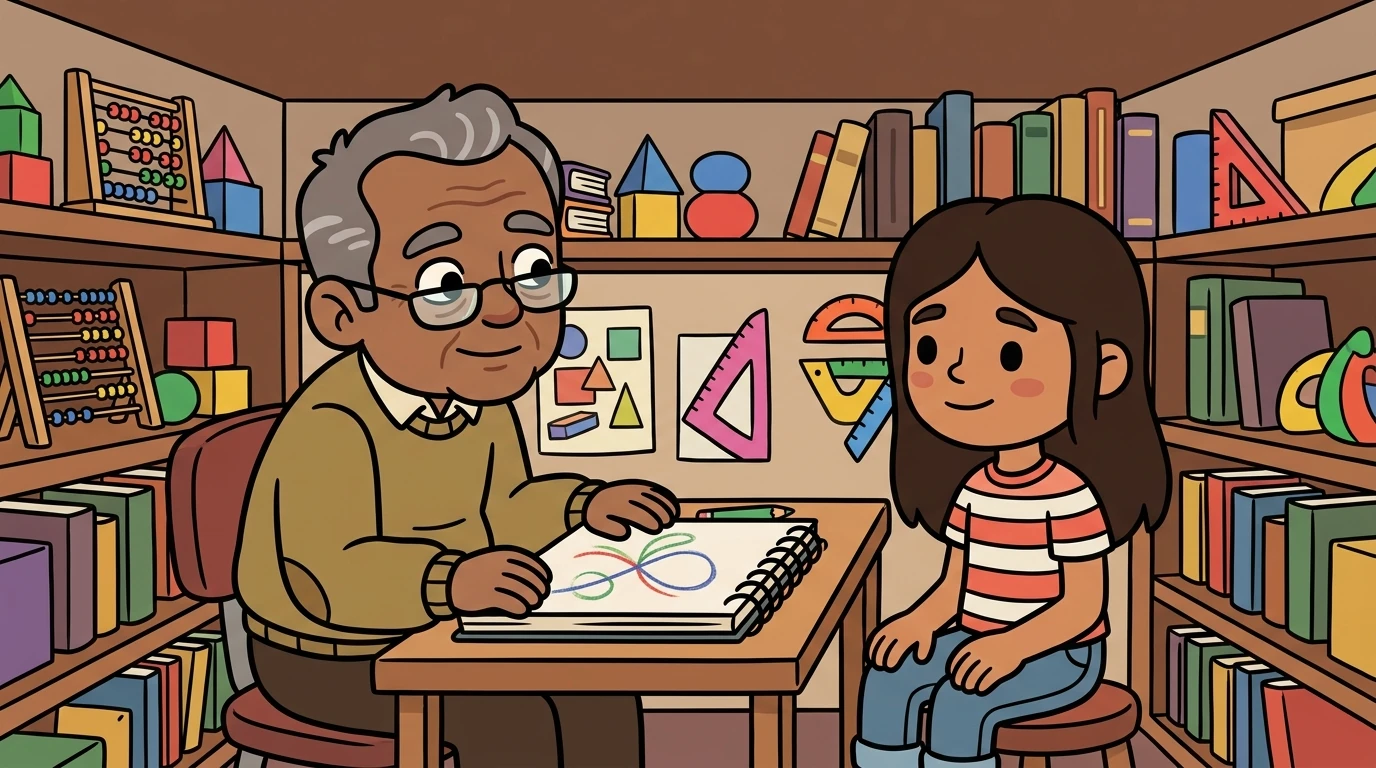
Maya was thirteen when she found out about the eleven-year-old who had cried.
She did not find out from Stretch. She found out from Practice Patience, on an afternoon when Maya had been working through the back room and had asked an offhand question about why Patience and Stretch argued so much.
"He stretched a girl once who wasn't ready," Patience had said, slowly, polishing a brass candlestick. "She was eleven. The problem was beyond her. She cried. She didn't come back for almost a year. Stretch has never quite forgiven himself."
Maya was quiet.
"Why did he do it?"
"Because he was younger. Because she had done a beautiful piece of work and he wanted to show her how much more was in it. Because his judgment about when was less sharp then than it is now. Because we all make mistakes in the timing of our gifts." Patience set the candlestick down. "He learned. He hasn't made the same mistake since. But the learning cost him something he hasn't gotten back."
That afternoon, Maya walked through the low alcove and ducked under the ceiling and sat down across from Stretch Sage. He was sketching a diagram of a curve she did not recognize.
"Stretch," she said, "thank you."
He looked up. He waited.
"Thank you for being careful with me," Maya said. "Patience told me about — about — "
"The girl who cried." Stretch said it plainly, the way you'd name a fact. "Yes."
"I'm sorry that happened."
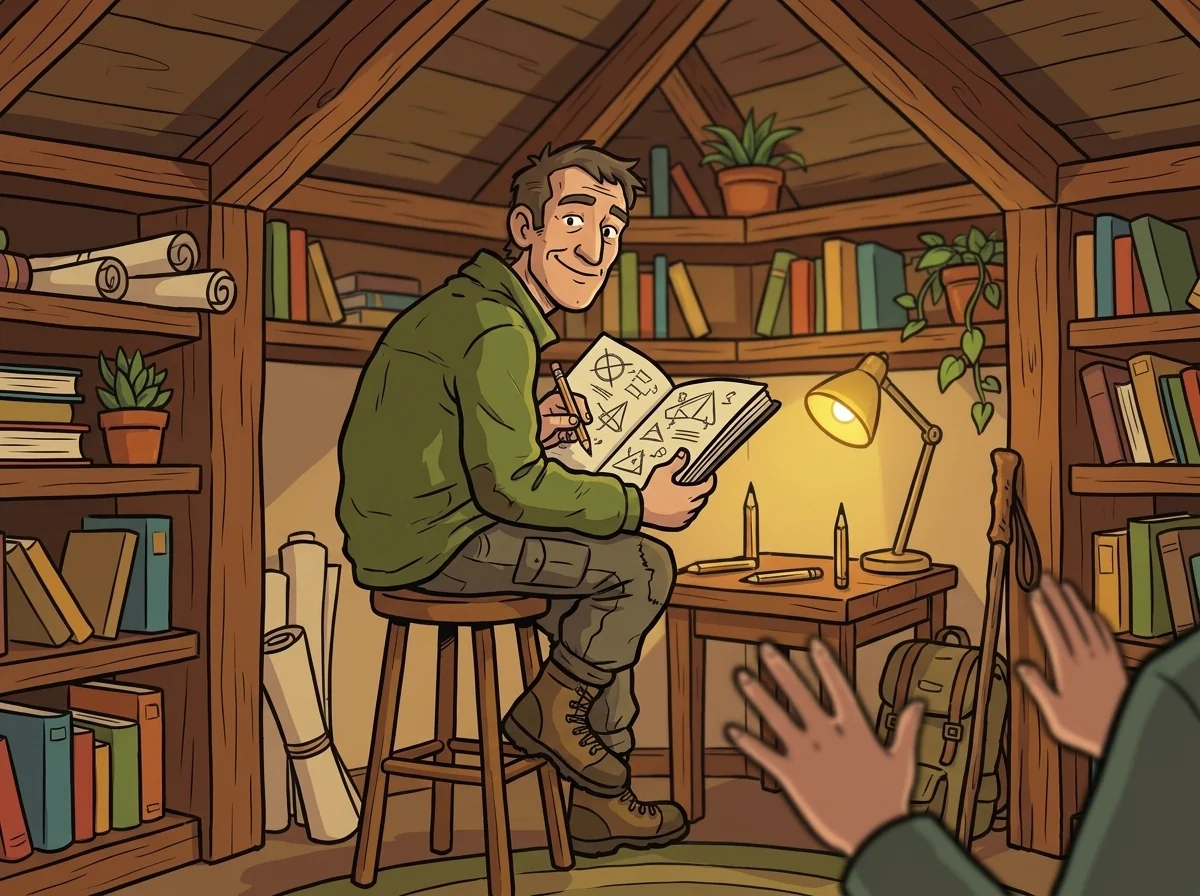
"So am I."
"I think you've been careful with me. I wanted you to know I notice."
Stretch looked at his sketch for a long moment. Then he put his pencil down.
"It's a hard thing to do well," he said. "The work I do. You can do it carelessly and produce readers who give up. You can do it tentatively and produce readers who never stretch. You have to find the seam between the two, and the seam is different for every reader, and the only way to find the seam is to make a thousand small mistakes and remember each of them."
He paused.
"What I owe you," he said, "is the memory of every mistake I made before you got here. That's what care is, in this work. It's the carried memory of who has been hurt before. It's the reason I'm careful with you specifically."
Maya did not know what to say.
She nodded.
Stretch picked up his pencil and went back to his sketch.
In Maya's fifteenth year, on a cold afternoon in late autumn, Maya brought Stretch a problem about quadratics that she had solved cleanly and elegantly and with the kind of small bright sparkle she had not been chasing for years now.
Stretch looked at it. He smiled — the small, deeply amused smile he had used on her the first day, when she was ten and adding three fractions had seemed unreasonable.
"This is good," he said. "What would happen if — "
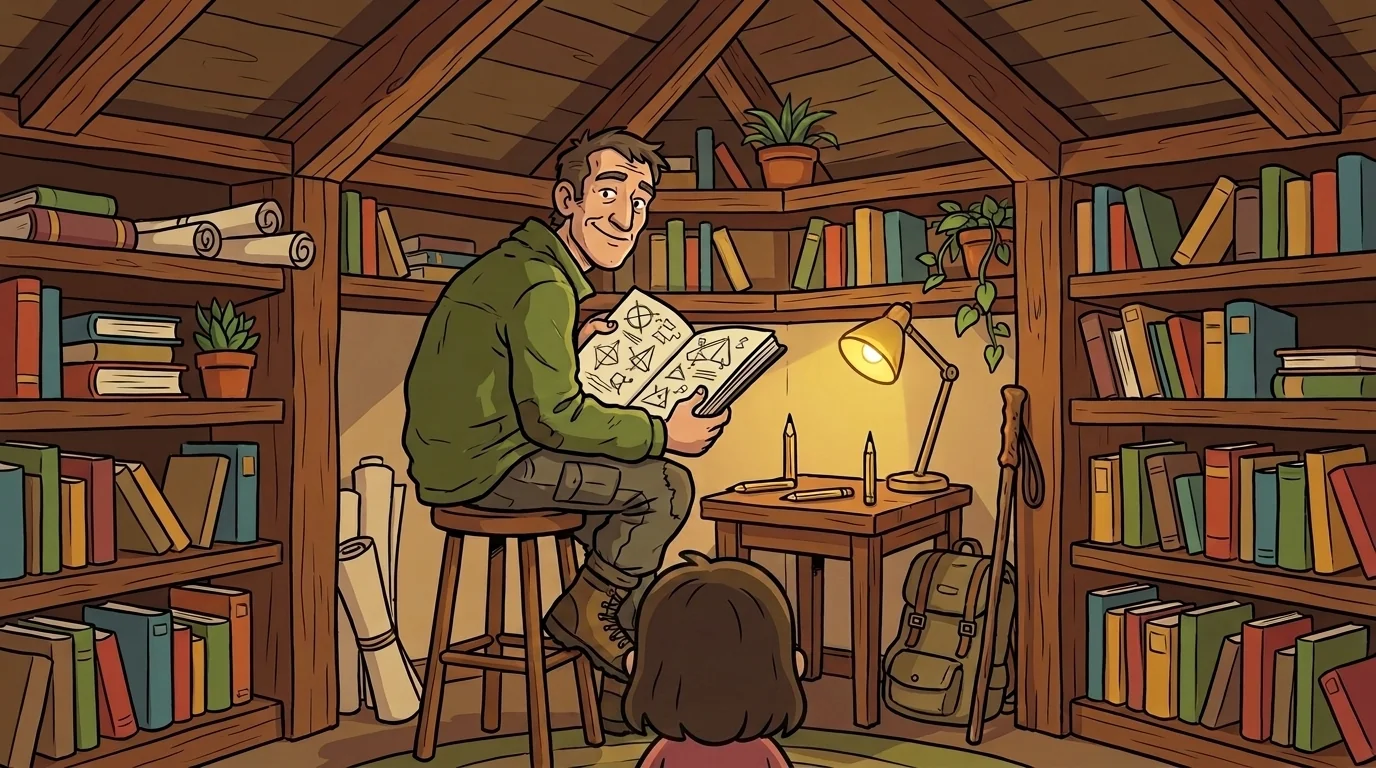
Maya was already grinning.
"Already thought about it," she said. "What if the quadratic had a fractional coefficient. What if there were three quadratics being added together. What if one of them was negative. What if the question wasn't asking for a root, but for the difference between two roots. What if I told you the whole thing was actually a parabola in disguise."
Stretch raised his eyebrows.
"You've been talking to me too long," he said.
"Yes."
"That's exactly what I would have said."
"I know."
"So what would happen if one of them was negative?"
Maya laughed.
"I haven't tried it yet," she said. "I came here so you could watch me try."
Stretch handed her a fresh sheet of paper. He went back to his sketch.
She tried.

She did not get the right answer on the first try. She did not get it on the second. She got it on the third, and the answer surprised her, and the surprise was the whole reward.
Stretch did not look up to watch her solve it. He had decided, decades ago, that watching too closely was its own kind of harm. He let her work alone. He listened to the sound of her pencil. He sketched.
When she finally said, "Got it," he looked up.
"What did the stretched version cost you?" he said.
"Almost an hour."
"What did you learn?"
"That negative coefficients change everything in a way I hadn't expected."
"What's the next corner?"
"I don't want to talk about the next corner right now. Right now I want to feel like I just did something good."
Stretch Sage smiled.
"Allowed," he said.
He went back to his sketch.
The AlcumusForge ensemble
Stretch Sage is part of AlcumusForge's distributed-narrative cast. Each character embodies a different curricular primitive; together they teach the full subject.
-

Alcuin
Librarian-detective of the practice graph; knows what to try next
-

Hint Hertha
Hint author and gentle redirector; never gives the answer
-

Practice Patience
Slow-tortoise back-room keeper; long-game adviser
-

Streak Bear
Warm anti-anxiety presence; the soft-streak character
-

Spacing Wren
Spaced review — bringing a topic back just before you'd forget it, so it sticks
-

Edge Goldi
Edge of competence — practicing at the just-right level where you grow fastest
-

Mistake Mabel
Mistakes as information — every error is a map to what to practice next
-

Mix Margo
Interleaving — mixing problem types so you learn to tell them apart and remember
-

Recall Remy
Retrieval practice — closing the book and recalling beats rereading